“Jonathan Drops Bombshell: Top Aide Withheld Yar’Adua’s Handover Letter, Plunging Nigeria Into Crisis”
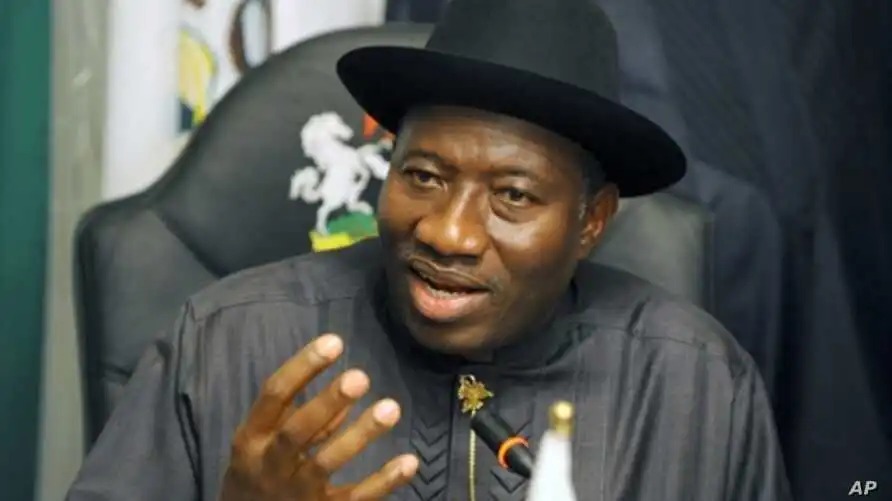
Former President Goodluck Jonathan has made a shocking disclosure about the constitutional crisis that rocked Nigeria in 2010, alleging that a top presidential aide deliberately withheld a crucial handover letter from the National Assembly during the prolonged illness of President Umaru Musa Yar’Adua.
Speaking in an interview with the Rainbow Book Club, the former president revealed that Yar’Adua had written a formal letter transferring power to him as acting president before departing for medical treatment abroad, but the aide refused to submit the letter, triggering a months-long power vacuum and constitutional uncertainty.
Jonathan explained that without the official letter, he was unable to function as Commander-in-Chief, even though he continued presiding over the Federal Executive Council as vice president.
“That letter was written, but the person who the letter was handed over to, I will not mention the name, refused to submit it to the National Assembly,” Jonathan said. “So we had a country where the president was not available, and there was no acting president.”
This development, he noted, left Nigeria in a dangerous limbo until the National Assembly invoked the “doctrine of necessity”, granting him emergency powers to act as president — a rare and controversial constitutional workaround.
Jonathan compared the delay unfavorably to the swift transfer of presidential powers in the United States, where even a brief medical procedure triggers a formal handover of authority.
“In America, if the president is undergoing surgery, even for five minutes, he hands over to the vice president. We stayed for some time without a commander-in-chief.”
Jonathan said part of the resistance to his assuming full presidential powers was rooted in Nigeria’s delicate ethno-religious balance, noting that Yar’Adua, a northern Muslim, had succeeded Olusegun Obasanjo, a southern Christian.
“Definitely, the northern Muslims wanted Yar’Adua to at least do eight years before power would return to the South,” he said. “But his health issues came up and it was a problem. That’s why even allowing me to act as president became an issue.”
Yar’Adua eventually passed away in May 2010, paving the way for Jonathan to become president and later contest and win the 2011 election.
In a separate interview on Talking Books Africa, Jonathan took aim at Nigeria’s deepening divisions along tribal and religious lines, warning that these sentiments continue to distort the country’s leadership selection process.
“Most of the problems we have today are because of these divisions,” he said. “Tribe and religion are major setbacks for this country.”
He lamented that many political appointments and elections are influenced by ethnic loyalty rather than competence, describing it as a core reason Nigeria struggles to recruit the best leadership.
“If Mrs A knows the job better than Mrs B, and Mrs B is from your tribe, you go with Mrs B. That is the bane of Nigerian politics.”
Referencing the success of the Not Too Young To Run movement, Jonathan urged young Nigerians to push for similar reforms in the criteria for leadership, especially the de-emphasis of age, ethnicity, and religion.
He cited historical examples like Yakubu Gowon, who became head of state at 32, and Alfred Diete-Spiff, who governed Rivers State at just 28, as proof that youthful leadership can deliver results.
“I don’t believe in all these barriers. Somebody can sleep for 40 years and know nothing. Another person at 25 could be more competent,” Jonathan said.
He concluded with a rallying call to Nigerian youths:
“If younger people can begin to gradually downplay the issue of religion in Nigerian politics, the leadership recruitment process will improve. We will begin to recruit people better.”
Jonathan’s dual message — exposing the hidden machinations behind a major constitutional crisis and advocating for a shift in Nigeria’s political culture — comes as public debate intensifies ahead of the 2027 elections.