Due Process Denied, Allegations Baseless — Ghana’s Chief Justice Torkornoo Decries Removal Tactics
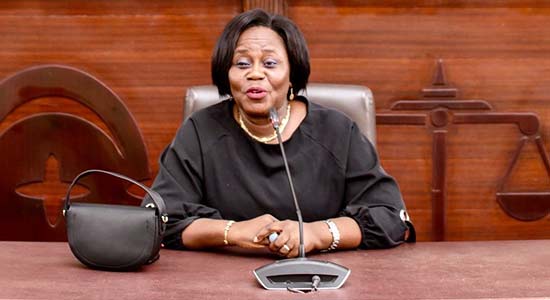
In a historic address to the nation, Chief Justice Gertrude Sackey Torkornoo has raised serious concerns about the ongoing process to remove her from office, describing it as a violation of Ghana’s Constitution and a threat to the country’s democratic institutions. Speaking at a press conference in Accra, the Chief Justice outlined four reasons for her public statement: the unprecedented nature of the removal process, its far-reaching implications for judicial and constitutional bodies, the irregularities and illegalities in the proceedings, and the broader impact on Ghana’s rule of law.
Chief Justice Torkornoo emphasized that in Ghana’s 68-year history as an independent republic, no Chief Justice has ever faced a removal hearing. She expressed dismay that the process, governed by Article 146 of the 1992 Constitution, is being conducted in a manner that “breaks every rule on how justice is delivered in the country.” The Chief Justice warned that the violations in her case could set a dangerous precedent for the removal of other judicial and constitutional officeholders, undermining the independence of key institutions designed to protect Ghanaian citizens’ freedom and justice.
The Chief Justice highlighted that the removal process affects not only her but also a range of public officials protected under Article 146, including Justices of the High Court, Court of Appeal, and Supreme Court, as well as Commissioners of the Commission on Human Rights and Administrative Justice (CHRAJ), the Auditor General, the Public Services Commission, the Electoral Commission, and the National Commission on Civic Education. She stressed that the Constitution’s framers intended for these officials to operate without fear of reprisal from influential figures, ensuring freedom and justice. However, the current process, she argued, threatens this independence.
Torkornoo detailed several violations in the Article 146 proceedings, which began after her suspension by President Nana Akufo-Addo on March 27, 2025, based on petitions from Mr. Daniel Ofori, a group called “Shining Stars,” and Mr. Ayamga Akolgo. She filed an action in the Supreme Court requesting a public hearing to ensure transparency, arguing that the secrecy of the proceedings was not justified by sensitive national interests. However, her application was denied, and a supplementary affidavit alleging human rights violations was struck out at the Attorney-General’s request.
Among the violations cited were:
Refusal to Recognize Counsel: The committee denied her counsel’s participation on the first day of proceedings because she was not personally present, violating natural justice principles.
Lack of Specific Allegations: The committee failed to provide specific charges or a prima facie determination, hindering her ability to prepare a defense.
Denial of Cross-Examination: Petitioners Daniel Ofori and Shining Stars were not required to testify, preventing cross-examination of their claims.
Personal Violations: Torkornoo was subjected to invasive searches and denied the presence of family members during hearings, breaching protocols extended to the Chief Justice.
Inappropriate Venue: The hearings are being held at Adu Lodge, a high-security facility linked to the 1981 murder of judges, which Torkornoo suggested was chosen to intimidate her. She noted her personal connection to the tragedy, as her uncle, Major Sam Acquah, was among the victims.
Non-Disclosure of Documents: The committee refused to provide copies of the petitions, her responses, or the President’s prima facie determination, violating procedural fairness.
Torkornoo also criticized the committee’s decision to treat the proceedings as adversarial litigation under the High Court (Civil Procedure) Rules, 2004 (CI 47), rather than an inquiry under the Commissions of Inquiry (Practice and Procedure) Rules, 2010 (CI 65). She argued that the committee lacked statutory authority to issue subpoenas, yet allowed petitioners to summon witnesses without testifying themselves, further undermining due process.
The Chief Justice addressed the three petitions against her:
Daniel Ofori’s Petition: Ofori’s claims include allegations of case transfers, misappropriation of funds for family travel, and administrative decisions. Torkornoo refuted these, providing evidence that transfers were due to a judge’s family crisis, travel was per Judicial Service policy, and administrative actions followed due process. She also noted a conflict of interest, as Justice Pwamang, who chairs the committee, previously ruled in Ofori’s favor in a case where she dissented.
Ayamga Akolgo’s Petition: Akolgo alleged Torkornoo ordered his arrest after a Supreme Court ruling, but his own exhibit—a media report—confirmed he was removed for disrupting the court. She highlighted that Justice Pwamang, also a panel member in Akolgo’s case, should not chair the committee.
Shining Stars’ Petition: This group, unregistered in Ghana, claimed Torkornoo failed to hear the Speaker of Parliament’s side in a case. She countered that Supreme Court decisions are collective, and judges are indemnified under Article 127(3) of the Constitution.
Torkornoo emphasized that the allegations lack merit, do not meet the constitutional threshold of “inability to perform the functions of their office,” and are based on misinformation or misinterpretations of her duties.
The Chief Justice warned that the proceedings threaten Ghana’s democratic progress, potentially compromising the independence of judges and constitutional officeholders. She referenced German Pastor Martin Niemoller’s 1946 quote to underscore the danger of remaining silent: “First they came for the socialists, and I did not speak out—because I was not a socialist… Then they came for me—and there was no one left to speak for me.” Torkornoo argued that allowing such a process to succeed could enable future removals based on frivolous petitions, undermining judicial integrity and public confidence.
Addressing calls to resign or retire, Torkornoo cited a Supreme Court precedent (J6/02/2019) that prohibits judges from resigning during Article 146 proceedings, as it could lead to loss of entitlements and validate false claims. She vowed to continue defending herself, stating, “As Chief Justice, I should not turn tail and run when I know the implications of not defending false and unwarranted charges.” She expressed confidence in her 38-year legal career and integrity, asserting that no one can credibly accuse her of corruption.
Chief Justice Torkornoo urged Ghanaians to recognize the unconstitutional nature of the proceedings and their potential to destabilize the judiciary. She called for public scrutiny to prevent a precedent that could endanger all judges and constitutional officeholders. “If this model of removal can be tried on the Chief Justice, it can be repeated with everyone,” she warned, emphasizing her duty to protect Ghana’s democratic institutions.
The Chief Justice concluded by reaffirming her commitment to the rule of law, stating, “I choose to trust that such darkness will not totally engulf this nation.” Her address has sparked widespread debate about judicial independence and constitutional adherence in Ghana, with legal experts and citizens calling for transparency and accountability in the Article 146 process. As the proceedings continue, Torkornoo’s statement serves as a clarion call to safeguard Ghana’s democratic journey.