“No Transfer Of Cases Adjourned For Judgment” — CJN Issues New Directives To Prevent Court Delays

The Chief Justice of Nigeria (CJN) and Chairman of the National Judicial Council (NJC), Hon. Justice Kudirat M.O. Kekere-Ekun, GCON, has issued new policy directives aimed at addressing concerns over disruptions caused by the transfer of cases and petitions against judicial officers.
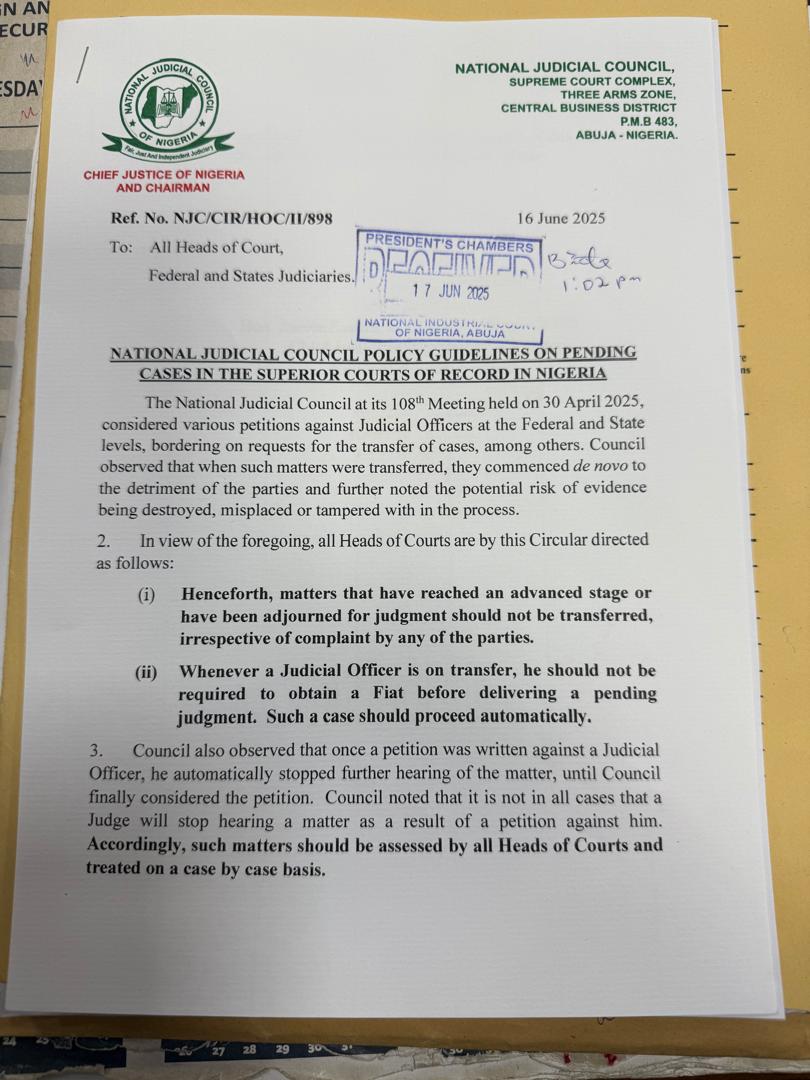
In a circular dated June 16, 2025, and marked NJC/CIR/HOC/II/898, the NJC directed all Heads of Courts across the Federation to implement the new guidelines to prevent unnecessary delays and miscarriages of justice in the adjudication process.
The directives were issued following the Council’s 108th Meeting held on April 30, 2025, where several petitions involving judicial officers at both federal and state levels were reviewed, including requests for case transfers.
According to the circular, the NJC expressed concern that transferred matters often start de novo (afresh), resulting in avoidable delays, loss or tampering of evidence, and injustice to the parties involved.
To mitigate this, the Council resolved as follows:
- No Transfer of Advanced Cases: Cases that have reached an advanced stage—particularly those adjourned for judgment—must not be transferred, regardless of any petition or complaint by the parties.
- Judges May Conclude Judgments After Transfer: Judicial officers who have been transferred will no longer require a fiat to deliver judgments in cases already heard and adjourned. Such cases are to continue to conclusion automatically.
- Petitions Not an Automatic Ground for Case Suspension: The Council noted that the filing of a petition against a judge should not automatically halt the judge from hearing a matter. Rather, such situations must be reviewed and determined on a case-by-case basis by the relevant Head of Court.
All Heads of Courts were instructed to disseminate the content of the circular to every judicial officer under their jurisdiction to ensure immediate compliance.
Justice Kekere-Ekun emphasized the NJC’s commitment to ensuring judicial efficiency, the integrity of the bench, and fair dispensation of justice, even amid increasing administrative and disciplinary complaints within the judiciary.