Oyebanji: Tackling the leadership question
 Leadership is key in any human organisation. It is the ability to guide, influence and inspire others to work together towards a common goal.
In any system, coordination is essesntial. But, it requires skills, which can be developed over time, for the management of human and material resorces for development and progress.
The principles of leadership are almost the same across board; in business, politics and community. These include vision, communication, leading by example, innovation or creativity and showing responsibility. Others are decision making, adaptability, consistency, focus, sound strategy, and risk taking.
Those who teach these values and traits are mere theorists or at best, motivation speakers. But, for those who lead, it is more complex because of the human variables involved in leading and followership, which are largely inconstant.
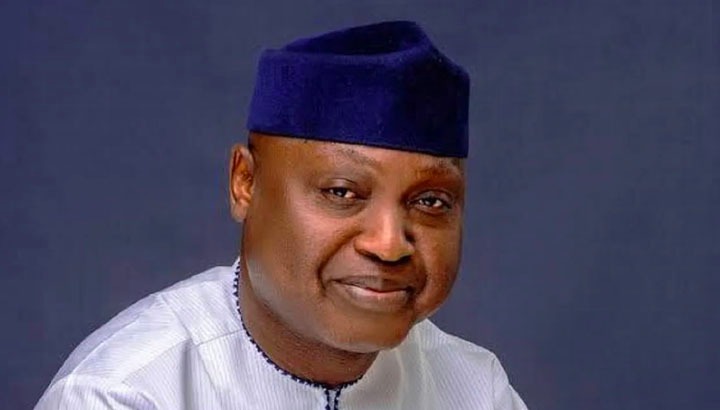
Biodun Oyebanji, political scientist, former university teacher and governor of Ekiti justified a blend of theory and practice when he delivered a lecture recently on the intricacies and complexity of leadership in Lagos as a guest of the Foursquare Church, Yaba.
Titled: ‘Leadership in Nigeria and its impact on the next generation, the lecture hosted by the General Overseer, Dr. Sam Aboyeji, was chaired by the boardroom guru, Mrs. Ibukun Awosika. It attracted many eminent Nigerians: politicians, businessmen and government officials.
The governor’s views aligned with those expressed by his Lagos State counterpart, Babajide Sanwo-Olu, and Awosika on the need to equip future leaders with necessary values.
But, to achieve this, the governor called for leadership training in schools. This is apt since learning will result in a change in behaviour.
From the vantage point of being a teacher, Oyebanji said: “Leadership must be part of the basic everyday skills that every citizen should possess. Leadership training must be as important as basic education for literacy and numeracy.
“As a nation, we should have embedded curriculum that teaches leadership skills and principles, both as practical skills and indoctrinated values. For me, I believe if you want to change a people, teach them what you want them to be”.
Awosika said Nigeria must nurture a generation of kings and empathetic leaders, who will understand that they are not necessarily the best among the citizens, but that they have been saddled with the responsibility to lead.
She also made a case for parents to lead in the leadership training, stressing that children would always grow and imbibe the values around them.
To Sanwo-Olu, it is important to nurture spiritual and political leadership in the younger ones. The governor, who was represented by the Secretary to the State Government, Bimbola Salu-Hundeyin, a lawyer, said the future of Nigeria rests on “our ability to nurture the next generation on the path of responsible leadership based on empathy.”
Oyebanji noted the leadership question has dominated public discourse, with many Nigerians describing the major problem of the country as leadership. “Indeed, the legendary literary giant, Chinua Achebe, once famously remarked in his book, The Trouble with Nigeria, that “the trouble with Nigeria is simply a failure of leadership,” he said.
He said the “problem” of not having “good leaders” has been a generational accusation, recalling that during the colonial era, young, patriotic, highly intelligent and courageous people confronted the colonial leadership as symbol of oppression. However, when power landed on their palms after independence, the new indigenous leaders also became victims of accusation of incompetence and corruption. Later, the soldiers who sacked them from power also became a “worse version” of their complaint. Therefore, Oyebanji contenteded that “our search for good leaders and the proclivity for each generation to accuse the ruling class of their time as incompetent, corrupt and visionless is as old as this country.” He added that after a leadership is displaced, “we soon become nostalgic of the “good old days” of their leadership. Thus, we have remained an experimental laboratory in search of the ideal leadership personality, system and model.” The implication is that it is sometimes difficult to really understand the nature of the leadership challenge in Nigeria since the dynamics of power struggle and oppositional politics can sometimes eclipse genuine leadership success.
Related News
My family has long history with UI – Gov Oyebanji
Ekiti 2026: My future is in God’s hands – Oyebanji
Oyebanji has fulfilled electoral promises to Ekiti people – Olatunbosun
Besides, leadership assessmen it could also be subjective, often determined by socio-political or ethno-religious affiliations, which makes the search for the ideal leadership to be harder, if not illusory.
The question then, is who is a leader. Oyebanji pointed that many have restricted the concept of leadership to the activities of public office holders. In his view, this is not only misleading, but also dangerous. He described leadership as the position of influence and authority to command compliance for the overall progress and development of a particular organisation. To that extent, the governor submittedthat the national leadership of a nation and its character are essentially, the sum total of the leadership behaviours of the leaders at different layers of the society.
However, a nation’s leadership starts from the household to the larger society. Every father, Oyebanji said, is a leader, every mother is a leader and every child is a leader.
Noting that at every level, the traits of leadership are identical, he added: “From being a class captain to becoming the president of a nation, the core values and skills of leadership are the same: responsibility, problem-solving, vision, fairness, firmness, prudence, transparency, temperance, resourcefulness, patience, responsiveness, creativity, accountability, fear of God, among others.” The governor emphasised that “one doesn’t need to hold political office to have these values and skills, nor should they get to public office before possessing them.”
Oyebanji called for leadership education, stressing that leadership training must be as important as basic education for literacy and numeracy. Indeed, a major problem with leadership recruitment in Nigeria, as he pointed out, is that, people, sometimes, just find themselves in leadership positions without the right aptitude and attitude. Oyebanji said faulty recruitment has made the country to gamble with leadership selection through trial by error. “We sometimes look for folk heroes or messiahs; at another time, we select leaders on the basis of geo-politics and ethno-religious considerations,” he added.
In his reckoning, there are those who become leaders by default or by circumstances of privileged pedigree and not because of personal merits. But, as he pointed out, “the best of leaders are those who have been trained, tested and exposed to the nitty-gritty of leadership, in addition to their innate ability.”
Another challenge is the lack of wherewithal by an average person to evaluate leadership competence due to the absenceof widespread knowledge about leadership as a skill.
Emphasising the value of training, Oyebanji said:”Leadership is such a serious thing that being certified should be one of the requirements to hold certain strategic positions in the society.
“Evidence abounds that technical skills on jobs are not enough for people to lead competently; there is the need for real and special training in the art and science of leadership for people to succeed today.”
He added:”People should go through intentional leadership training before they can lead at some certain levels in the society. We all need to be well exposed to the call of leadership and how to manage a mass audience of people with differing characteristics, needs and tendencies”
Oyebani said Ekiti is serious about preparing the next generation of leaders through its ’catch-them-young’ curriculum that prepares future leaders for leadership positions right from the primary school.
He stressed: “As a result, we currently run a compulsory subject called Ekiti Values Education (EVE) with a considerable module that focuses on leadership development. The subject aims to teach young Ekiti children comprehensive aspects of leadership, responsibility of a leader and practical leadership exposure.
“It aims to raise their self-awareness about their individual roles as a member of the future leadership and to prepare them to face the challenge of nation building. “Even as we grapple with the challenges of this generation, we owe the future generation, in addition to providing pedagogical framework, the responsibility of personal example. This is because it is in the nature of young people to emulate their leaders.
“So, where we have found ourselves as leaders, be it as traditional rulers, community leaders, religion leaders, business leaders, union leaders, professional leaders, academic leaders, judicial, legislative or executive leaders, we have a duty to be the paragon of example for the next generation.” He alluded to a quotation from the Maxwell Leadership Bible on our Lord Jesus Christ leadership model, saying: The governor best leadership simply expresses who we are . Jesus led from who He was: God incarnate, the perfect expression of the Father. As He pursued His divine mission, He influenced others. Similarly, as we pursue who God called us to be, our leadership will be most natural and effective”.